Price gap
A gap appears when a stock opens clearly above the previous day's high or below its low, usually after news outside trading hours such as earnings. On the chart an empty area remains between the two days.
Types of gaps
- Common gap: small, inside a range, often filled within days.
- Breakaway gap: out of a range on news and high volume, often the start of a new move.
- Exhaustion gap: late in a long move, followed by a reversal.
Whether a gap gets "filled" is not a rule. Gaps after strong earnings surprises often keep drifting in the gap direction, see PEAD.
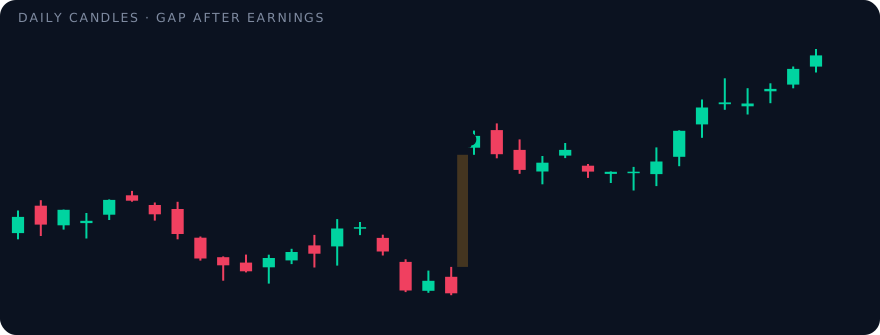
Risk for traders
A gap can jump over a stop: if a stock closes at $50 with a stop at $48 and opens at $44, the stop is filled near $44, not at $48. Holding through earnings carries this risk, which is why many traders reduce size before the report.
Frequently asked questions
Do gaps always get filled?
No. Many common gaps do, but breakaway gaps after news often never close.
Why are gaps important for stop-losses?
Because a stop order only triggers when trading resumes. After a gap the fill can be far worse than the stop price.
See it in the screener
The live demo shows every term with example data, right next to the score and its reasons.