Theta
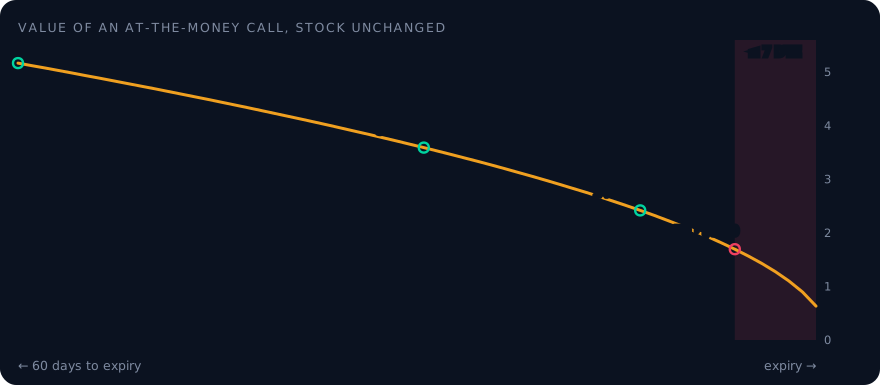
How much value an option loses per day purely through the passage of time. Decay speeds up sharply in the final weeks before expiry.
How fast time decay speeds up
An at-the-money call on a fictional $100 stock with IV of 30 % loses roughly this much value per day if nothing else changes:
| Days to expiry | Option price | Loss per day |
|---|---|---|
| 60 | $5.17 | about $0.05 |
| 30 | $3.59 | about $0.06 |
| 14 | $2.42 | about $0.09 |
| 7 | $1.70 | about $0.13 |
| 3 | $1.10 | about $0.21 |
In the last week the daily loss is more than twice as high as with a month left, and relative to the price it is far higher.
What this means for buyers
Theta works against every long option, every day, including weekends. The stock has to move far enough and fast enough to outrun it. That is why buyers usually choose more time than the idea needs (DTE) and exit before the steep part of the curve. The screener's rule is to close long options by 7 days to expiry at the latest.
Common mistakes
- Buying weekly options for a slow idea. The idea may be right, but the option runs out of time first.
- Holding into the final days hoping for a move. The remaining time value shrinks fastest exactly then.
- Looking only at theta per day. A cheap option losing $0.10 a day can lose a larger share of its value than an expensive one losing $0.15.
Frequently asked questions
Does theta decay on weekends?
Yes. Option prices account for calendar days, so the time value over a weekend is usually priced out by Friday's close or Monday's open.
Why does the screener avoid very short expiries?
Because decay accelerates sharply. Even short-term setups get at least 14 days to expiry so that enough time value is left when you exit.
See it in the screener
The live demo shows every term with example data, right next to the score and its reasons.